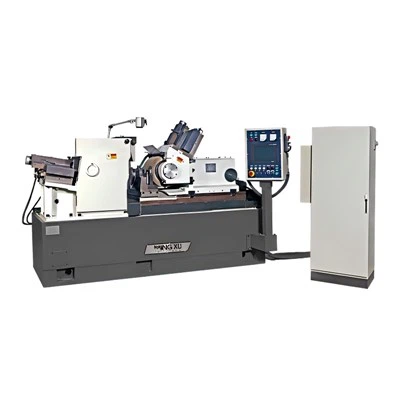
Hey there, folks! I’m a supplier of manual surface grinders, and today I wanna chat about the difference between manual surface grinders and automatic surface grinders. It’s a topic that comes up a lot when people are looking to buy a surface grinder for their workshop or manufacturing business. So, let’s dive right in! Manual Surface Grinder
How They Work
First off, let’s talk about how these two types of grinders operate. A manual surface grinder is, well, as the name suggests, operated manually. You’re the one in control here. You use handwheels to move the table, adjust the grinding wheel, and set the cutting depth. It’s like an old – school, hands – on approach. You gotta have a good feel for what you’re doing, kind of like a chef knowing exactly how much seasoning to add to a dish.
For example, when you’re grinding a small, precision part, you can make small, incremental adjustments on the fly. You see how the grinding is going, and if it’s not just right, you turn the handwheel a little more or less. It gives you that direct connection with the machining process.
On the other hand, an automatic surface grinder is more like a high – tech robot. It’s programmed to do its thing. You input the specifications like the size of the workpiece, the required finish, and the cutting parameters into a control panel. Once you hit start, the grinder takes over. It moves the table, adjusts the wheel speed and position all by itself. It’s great for mass – production because it can keep repeating the same operation over and over again with very little deviation.
Precision and Flexibility
When it comes to precision, both types can deliver great results, but in different ways. Manual surface grinders are excellent for delicate and customized work. Since you’re in direct control, you can achieve a very high level of precision on small, one – off parts. You can adapt to the unique characteristics of each workpiece. Say you have a part with an irregular shape. You can gently guide the grinding wheel around it, making sure every edge and contour is just right.
But precision on a manual grinder also depends a lot on the operator’s skill. A seasoned operator can produce parts with incredibly tight tolerances. However, if you’re new to the game, it might take some time to get the hang of it.
Automatic surface grinders are all about consistent precision. They are designed to hit the same specifications every time. For large – scale production, this is a huge advantage. You can be sure that every part coming off the machine will be within the specified tolerance range. But they’re not as flexible as manual grinders when it comes to handling unique or complex workpieces. Changing the program for a different part can be time – consuming and requires some technical know – how.
Cost
Cost is always a big factor when making a purchasing decision. Manual surface grinders are generally more affordable upfront. They don’t have all the fancy electronics and programming systems that automatic grinders do. So, if you’re on a tight budget, a manual grinder can be a great option. You can get a decent – quality manual surface grinder for a relatively low price, which is perfect for small businesses or hobbyists.
But there’s also the cost of operation to consider. Manual grinders rely on human labor, which means you need to pay an operator. And if the operator isn’t very efficient, it can add to the cost.
Automatic surface grinders, on the other hand, are more expensive to buy. The advanced technology and control systems drive up the price. However, in the long run, they can save you money on labor costs, especially for high – volume production. Once the machine is set up, it can run with minimal supervision, so you don’t need to pay an operator to stand there all day.
Setup Time
Setting up a manual surface grinder is usually quicker. You just need to mount the workpiece, adjust the wheel, and you’re ready to go. It’s a straightforward process, especially if you’re used to working with manual machines. You can make small adjustments as you go, so you don’t have to plan everything out in advance.
With an automatic surface grinder, the setup time can be longer. You need to program the machine, which involves inputting all the details about the workpiece and the grinding operation. This can be a bit complicated, especially if you’re dealing with a complex part. However, once the setup is done, you can produce parts much faster than with a manual grinder.
Learning Curve
If you’re new to surface grinding, a manual surface grinder might be a better place to start. The learning curve is relatively gentle. You can start with simple parts and gradually build up your skills. You learn how the machine works, how to control the grinding process, and how to achieve different finishes. It’s a hands – on way to learn the fundamentals of surface grinding.
An automatic surface grinder has a steeper learning curve. You need to understand how to program the machine, which involves learning a new set of skills. But once you get the hang of it, you can take advantage of all the advanced features and capabilities of the machine.
Suitability for Different Jobs
Manual surface grinders are ideal for small – scale production, prototyping, and custom work. If you need to make a few parts with unique specifications, a manual grinder is the way to go. It allows you to be creative and make adjustments on the fly. For example, in a custom jewelry workshop, a manual surface grinder can be used to shape and polish small, intricate pieces.
Automatic surface grinders shine in high – volume production environments. They can churn out parts quickly and consistently. In a large manufacturing plant that produces thousands of the same part every day, an automatic surface grinder is a must – have. It can increase productivity and reduce the chances of human error.
Maintenance
Maintenance for a manual surface grinder is generally simpler. There are fewer electronic components, so there’s less that can go wrong. You mainly need to keep the machine clean, lubricate the moving parts, and change the grinding wheel when it wears out. It’s something that an operator can handle with a basic understanding of machinery maintenance.
An automatic surface grinder has more complex maintenance requirements. The control systems and electronics need to be regularly checked and calibrated. Software updates might also be required. Maintenance often needs to be carried out by a trained technician, which can add to the cost and downtime of the machine.
Wrap – Up and Call to Action
So, there you have it, the main differences between manual surface grinders and automatic surface grinders. Each has its own advantages and disadvantages, and the right choice for you depends on your specific needs, budget, and the type of work you do.

If you’re in the market for a manual surface grinder, I’m here to help. I’ve got a great selection of high – quality manual surface grinders that can meet your requirements. Whether you’re a small business owner, a hobbyist, or just looking to add a versatile machine to your workshop, I’ve got the perfect solution for you.
Wide-Wheel Centerless Grinder Don’t hesitate to reach out if you’ve got any questions or want to discuss your options. We can have a detailed chat about which grinder would be the best fit for your operations. Let’s work together to make your grinding projects a success!
References
- Smith, J. (2018). Handbook of Surface Grinding Techniques.
- Brown, A. (2019). Comparison of Manual and Automatic Machining Processes.
- Miller, R. (2020). The Economics of Machine Tool Selection.
Wuxi Mingxu Machinery Equipment Co., Ltd.
As one of the most professional manual surface grinder manufacturers and suppliers in China, we’re featured by quality products and good price. Please rest assured to buy the best manual surface grinder for sale here from our factory. Also, custom service is available.
Address: No. 5-5 Jinke Wealth Plaza, Changjiang North Road, Xinwu District, Wuxi City, Jiangsu Province
E-mail: yingyingmxjd@163.com
WebSite: https://www.mingxu-china.com/
