Nylon staple fiber is a versatile and widely – used synthetic fiber known for its excellent mechanical properties, abrasion resistance, and chemical stability. As a nylon staple fiber supplier, understanding its crystallization properties is crucial, not only for a deeper insight into the product but also for guiding customers in their applications. Nylon Staple Fiber

Crystallization Mechanism of Nylon Staple Fiber
Nylon is a polyamide, which is formed by the polymerization of diamines and dicarboxylic acids or lactams. During the production of nylon staple fiber, the macromolecular chains in the molten state gradually align and pack regularly as the temperature drops, leading to the formation of crystals.
The crystallization process of nylon staple fiber is a complex thermodynamic and kinetic process. Thermodynamically, the system tends to minimize its free energy. The formation of crystals allows the nylon molecules to arrange in a more ordered state, reducing the free energy of the system. Kinetically, the crystallization rate is affected by factors such as temperature, molecular weight, and the presence of external forces.
At the molecular level, the amide groups in nylon chains can form hydrogen bonds with each other. These hydrogen bonds play a vital role in the crystallization process. They promote the parallel alignment of the molecular chains, which is a prerequisite for crystal formation. When the nylon melt starts to cool, the hydrogen – bonded molecular chains begin to aggregate, and small crystal nuclei are formed. As time passes, these nuclei grow by incorporating more nylon molecules, leading to the growth of crystals.
Factors Affecting the Crystallization of Nylon Staple Fiber
Temperature
Temperature is one of the most critical factors affecting the crystallization of nylon staple fiber. There is an optimum crystallization temperature range for nylon. At high temperatures close to the melting point, the molecular chains have high mobility, but the driving force for crystallization is low because the free energy difference between the molten and crystalline states is small. As the temperature decreases, the driving force for crystallization increases. However, if the temperature is too low, the molecular chain mobility is severely restricted, and the crystallization rate becomes very slow.
For example, in the production process, when the nylon melt is extruded through the spinneret and then cooled, the cooling rate determines the crystallization degree and crystal size of the fiber. A rapid cooling rate will result in a smaller crystal size and a lower degree of crystallization because the molecular chains do not have enough time to arrange into large – scale ordered structures. On the other hand, a slow cooling rate allows for more complete crystallization, resulting in larger crystal sizes and a higher degree of crystallization.
Molecular Weight
The molecular weight of nylon also has a significant impact on its crystallization properties. Generally, nylon with a lower molecular weight has a higher crystallization rate. This is because shorter molecular chains have higher mobility and can more easily arrange themselves into ordered crystal structures. In contrast, high – molecular – weight nylon has longer chains that are more entangled, which hinders the movement of the chains and slows down the crystallization process.
However, high – molecular – weight nylon can form a more perfect and stable crystal structure once crystallization occurs. This is because the longer chains can provide more opportunities for hydrogen – bonding and chain – packing, resulting in a more ordered and stronger crystal lattice.
Additives
Additives can be used to modify the crystallization properties of nylon staple fiber. Nucleating agents are commonly used additives. These agents provide additional sites for crystal nucleation, increasing the number of crystal nuclei and thus promoting the crystallization process. As a result, the crystallization rate is accelerated, and the crystal size is reduced. This can improve the mechanical properties of the fiber, such as its stiffness and tensile strength.
Plasticizers, on the other hand, can increase the mobility of the nylon molecular chains by reducing the intermolecular forces. This can lower the melting point and the glass – transition temperature of nylon, and also affect its crystallization behavior. In some cases, plasticizers can promote crystallization at lower temperatures by facilitating the movement of the chains.
Crystallization and the Properties of Nylon Staple Fiber
Mechanical Properties
The crystallization of nylon staple fiber has a profound impact on its mechanical properties. The crystalline regions in the fiber act as physical cross – links, providing strength and stiffness. Fibers with a higher degree of crystallization generally have higher tensile strength and modulus. This is because the ordered arrangement of the molecular chains in the crystals can effectively resist deformation under stress.
However, an excessive degree of crystallization can also make the fiber more brittle. The large and perfect crystals may have fewer tie – molecules connecting different crystal regions. When the fiber is subjected to external forces, these crystals may break easily, leading to a reduction in the fiber’s toughness. Therefore, a proper balance of crystallization is necessary to achieve the best combination of strength and toughness.
Thermal Properties
The crystallization of nylon also affects its thermal properties. The melting point of nylon is related to its degree of crystallization. Fibers with a higher degree of crystallization have a higher melting point because more energy is required to break the ordered crystal structure and convert the nylon from the solid to the molten state.
In addition, the crystallization can influence the thermal expansion coefficient of the fiber. Crystalline regions are more rigid and have a lower thermal expansion rate compared to the amorphous regions. Therefore, fibers with a higher degree of crystallization generally have a lower thermal expansion coefficient, which is beneficial in applications where dimensional stability is required at different temperatures.
Chemical Resistance
The crystallization of nylon staple fiber can enhance its chemical resistance. The ordered crystal structure can act as a barrier, preventing the penetration of chemical substances into the fiber. For example, in the presence of solvents or chemicals, the crystalline regions are less likely to be attacked by the chemicals, protecting the overall integrity of the fiber. However, the amorphous regions are more vulnerable to chemical attack, so a higher degree of crystallization can improve the fiber’s overall chemical resistance.
Implications for Applications
Understanding the crystallization properties of nylon staple fiber is of great significance for various applications. In the textile industry, the mechanical and thermal properties of the fiber determined by its crystallization are crucial for the performance of the final textile products. For example, in the production of sportswear, fibers with a proper degree of crystallization can provide the right combination of strength, stretchability, and dimensional stability.
In the automotive industry, nylon staple fiber is often used in the production of carpets, seat covers, and other interior components. The chemical resistance and thermal stability related to crystallization are important to ensure the durability and performance of these components under different environmental conditions.
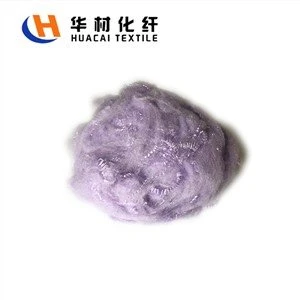
As a nylon staple fiber supplier, we are committed to providing high – quality products with well – controlled crystallization properties. Our R & D team continuously studies and optimizes the production process to ensure that the crystallization degree and crystal size of the fiber meet the specific requirements of different applications.
Nylon Staple Fiber If you are interested in our nylon staple fiber products and want to discuss your specific needs, we welcome you to contact us for a procurement negotiation. We have a professional sales and technical support team ready to provide you with detailed product information and customized solutions.
References
- Billmeyer, F. W. Jr. (1984). Textbook of Polymer Science. John Wiley & Sons.
- Mark, H. F. (Ed.). (1996). Encyclopedia of Polymer Science and Engineering. John Wiley & Sons.
- Ziabicki, A. (1976). Fundamentals of Fiber Formation: The Science of Fibre – Spinning and Drawing. Wiley – Interscience.
Huacai Group
Huacai Group is well-known as one of the leading nylon staple fiber manufacturers and suppliers in China, featured by quality products and good service. Please feel free to buy bulk nylon staple fiber at competitive price from our factory.
Address: No.188 Zhenyang Road, Qingyang Town, Jiangyin City, Jiangsu Province, China
E-mail: sales@huacaifiber.com
WebSite: https://www.huacaifiber.com/
